Is There a Junk File I Can Print to in Linux
Nigh of united states of america will costless up the disk space whenever we face up out of deejay space on Linux system.
It should be performed frequently, to brand space for installing any new application and dealing with other important files.
Housekeeping is one of the routine chore of Linux ambassador, which allows them to maintain the deejay utilization which is under threshold.
There are several ways to make clean up our organisation space.
There is no need to clean upwardly your organization when you take enough storage chapters.
But if your have limited space and so freeing upward disk space becomes a necessity.
In this commodity, I'll evidence yous some of the easiest or unproblematic means to clean upwardly your Ubuntu arrangement and get more space.
How to bank check Free Space on Ubuntu systems?
Use df Command to cheque current deejay utilization on your organization.
$ df -h Filesystem Size Used Avail Utilize% Mounted on udev 975M 0 975M 0% /dev tmpfs 200M 1.7M 198M one% /run /dev/sda1 30G 16G 13G 55% / tmpfs 997M 0 997M 0% /dev/shm tmpfs 5.0M 4.0K 5.0M 1% /run/lock tmpfs 997M 0 997M 0% /sys/fs/cgroup
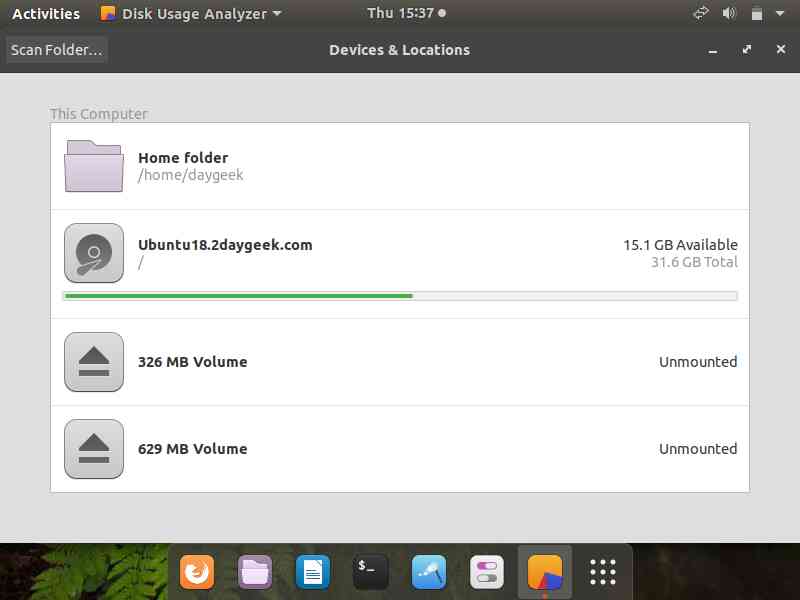
GUI users can utilise "Deejay Usage Analyzer tool" to view current usage.
1) Remove the unwanted packages that are no longer required
The following control removes the dependency libs and packages that are no longer required by the system.
These packages were installed automatically to satisfy the dependencies of an installed parcel.
Likewise, it removes erstwhile Linux kernels that were installed in the system.
It removes orphaned packages which are not longer needed from the system, simply not purges them.
$ sudo apt-go autoremove [sudo] countersign for daygeek: Reading package lists... Done Edifice dependency tree Reading land information... Washed The post-obit packages will be REMOVED: apache2-bin apache2-data apache2-utils galera-3 libaio1 libapr1 libaprutil1 libaprutil1-dbd-sqlite3 libaprutil1-ldap libconfig-inifiles-perl libdbd-mysql-perl libdbi-perl libjemalloc1 liblua5.2-0 libmysqlclient20 libopts25 libterm-readkey-perl mariadb-client-x.1 mariadb-client-core-ten.1 mariadb-common mariadb-server-10.ane mariadb-server-cadre-10.1 mysql-common sntp socat 0 upgraded, 0 newly installed, 25 to remove and 23 not upgraded. After this operation, 189 MB disk space will be freed. Practice you want to proceed? [Y/n]
To purge them, use the --purge option together with the command for that.
$ sudo apt-get autoremove --purge Reading packet lists... Done Building dependency tree Reading land information... Washed The post-obit packages will be REMOVED: apache2-bin* apache2-data* apache2-utils* galera-3* libaio1* libapr1* libaprutil1* libaprutil1-dbd-sqlite3* libaprutil1-ldap* libconfig-inifiles-perl* libdbd-mysql-perl* libdbi-perl* libjemalloc1* liblua5.ii-0* libmysqlclient20* libopts25* libterm-readkey-perl* mariadb-client-x.ane* mariadb-customer-cadre-10.i* mariadb-mutual* mariadb-server-10.1* mariadb-server-core-x.1* mysql-common* sntp* socat* 0 upgraded, 0 newly installed, 25 to remove and 23 not upgraded. After this operation, 189 MB disk space will be freed. Do you want to continue? [Y/n]
two) Empty the Trash Can
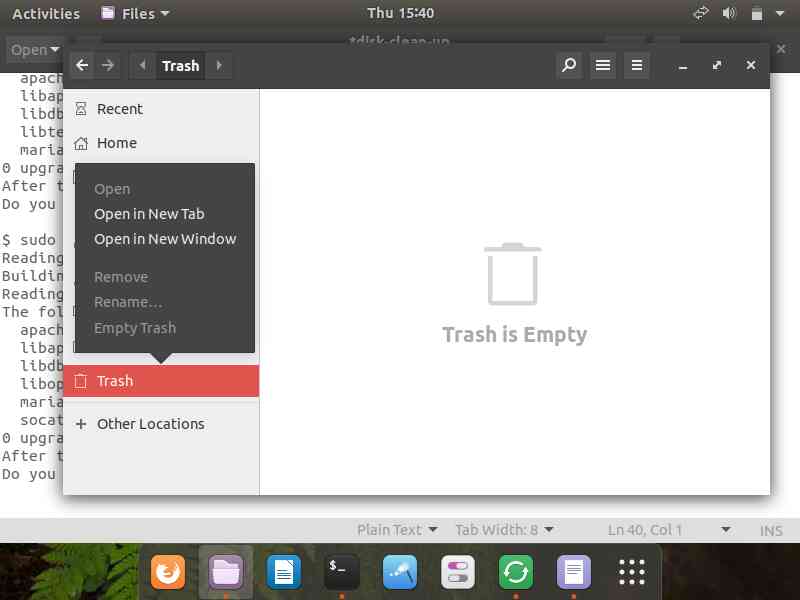
There might a be chance, that you may have a large amount of useless information residing in your trash.It takes upwards your organization infinite. This is one of the all-time mode to make clean up those and get some free infinite on your system.
To clean up this, simply apply the file managing director to empty your trash tin can.
3) Make clean up the APT cache
Ubuntu uses APT Command (Advanced Packet Tool) for package management like installing, removing, searching, etc,.
By default every Linux operating organisation keeps a enshroud of downloaded and installed packages on their respective directory.
Ubuntu as well does the same, it keeps every updates it downloads and installs in a enshroud on your disk.
Ubuntu system keeps a enshroud of DEB packages in /var/cache/apt/archives directory.
Over fourth dimension, this cache can quickly abound and hold a lot of infinite on your system.
Run the following command to cheque the current utilization of APT cache.
$ sudo du -sh /var/cache/apt 147M /var/cache/apt
It cleans obsolete deb-packages. I mean to say, less than clean.
$ sudo apt-go autoclean
It removes all packages kept in the apt cache.
$ sudo apt-get clean
four) Uninstall the unused applications
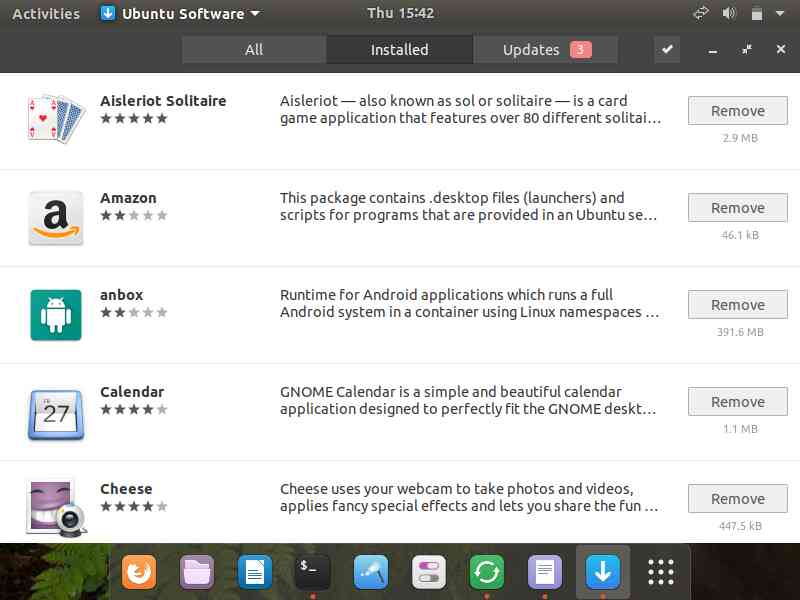
I would request you to check the installed packages and games on your organization and delete them if you are using rarely.
This can exist hands done via "Ubuntu Software Centre".
5) Clean up the thumbnail cache
The cache folder is a identify where programs stored data they may need once again, information technology is kept for quick access but is non essential to proceed. It can exist generated again or downloaded once again.
If it's actually filling upwardly your hard drive then you can delete things without worrying.
Run the following command to check the current utilization of APT cache.
$ du -sh ~/.cache/thumbnails/ 412K /home/daygeek/.cache/thumbnails/
Run the following control to delete them permanently from your arrangement.
$ rm -rf ~/.cache/thumbnails/*
Source: https://www.2daygeek.com/linux-remove-delete-unwanted-junk-files-free-up-space-ubuntu-mint-debian/

Post a Comment for "Is There a Junk File I Can Print to in Linux"